

I wanted to write a post that captured my astonishment at how the unstoppable beast that is AI has tiptoed over into a place that has nailed the concepts of emotion and feeling—something that has, for now, managed to offer most people exposed to this developing technology the ability to discern man from machine.
Yes, I understand that to some people, that may sound like an untenable concept—madness, almost! Yet, as things move forward at the rate they are, it is almost impossible to tell the difference when interacting online. We have reached a new era where most of the things you watch online require scrutinizing the bio sections for AI labelling. Fake news and deepfakes pollute the space, algorithms feed you adverts full of recognizable faces selling products they’re simply not related to... Add this to the new tools afforded to scammers and hackers for duping the unsuspecting into parting with their hard-earned cash, and things start to look very dark.
Given the space I operate in, this obviously throws up some relevant concerns—beyond the obvious worries about people forming relationships with computers (often said I spend more time with mine than with the family), building their views on falsified information, and the classic projections of success and unachievable results derived by algorithms, often targeted at the less fortunate. I can’t help but recognize the problems created, both immediate and ethical, when considering the ideas of AI in therapeutic spaces.
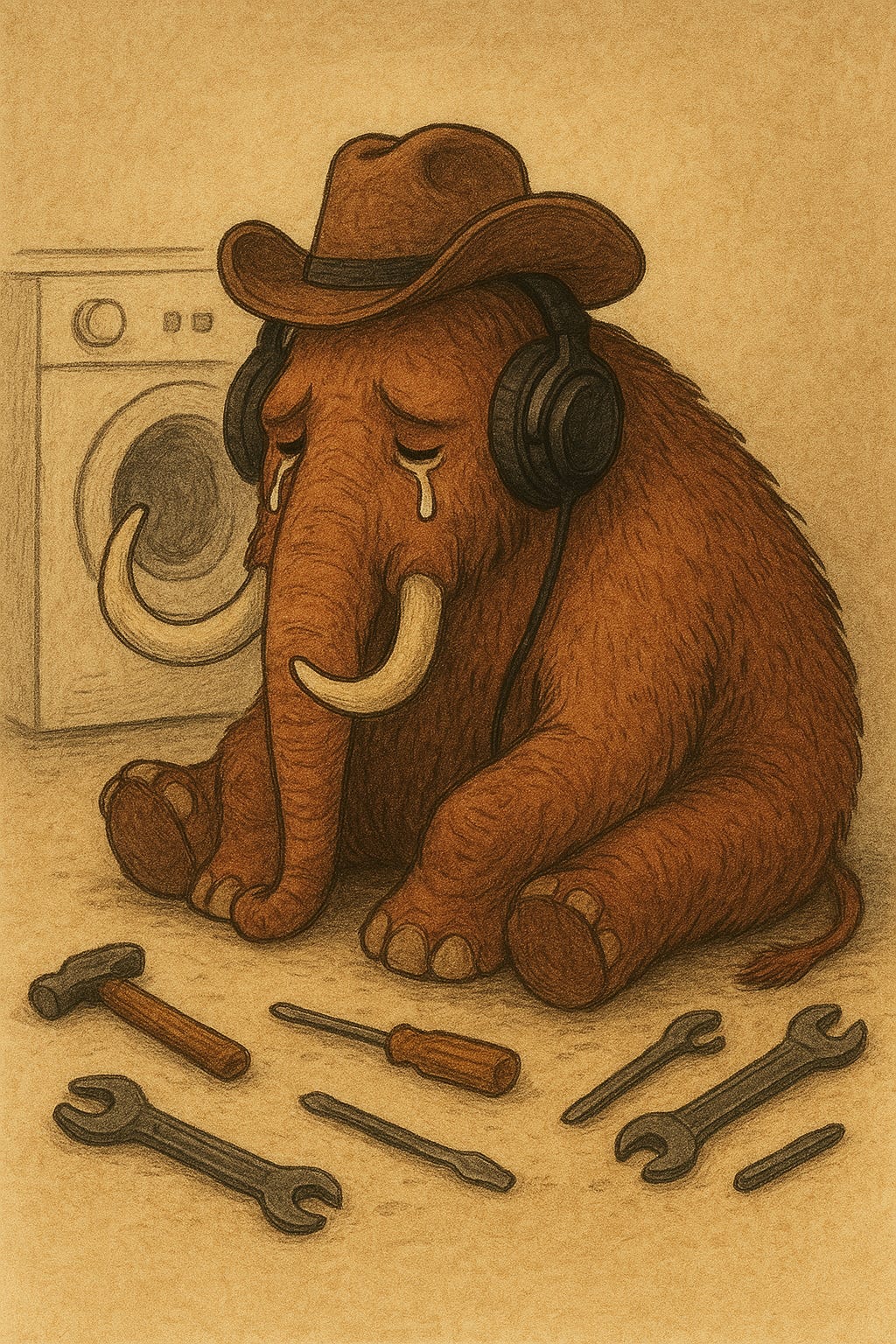
I’ll put my hand up and say I absolutely embrace the technology—in fact, I use it daily. It may surprise you somewhat, but I’m not a graphic designer; my catalogue of mammoth images is AI-aided, as is a lot of my back office. I use it when researching topics, to explore concepts briefly for relevance, and even when building my academic plans for my own concepts. It’s surprisingly useful for gathering large swaths of research papers, and honestly, I cannot wait until it’s at a level that will remove the data-entry aspect of lab work. However, it has always had recognizable limitations, mainly in the form of the odd hallucination, biased data sets, and even programmed ideologies.
When considering the therapeutic angles of the practice, although the support it may offer—when instructed to do so—can emulate therapeutic responses to a fashion, it has always been recognizable as a non-entity response. The main reason for this is that it has been obviously hampered by its inability to capture emotion, feeling, and, well... soul. Although the responses it offers often hit the mark—and if you’re not trained in the practice, it would be hard to recognize the differences in the ideas of empathy—it has always lacked that sense of understanding and encompassing the human condition. Well, I hate to say it, but no more!
Grief is a funny animal, and as stated above, this post started out rather different. However, I’d like to offer you a little insight into how my emotional connection, a washing machine (a broken washing machine), and a memory bridged the gap between man and machine in a way I just would never have conceived as possible. Cringe warning: this is not necessarily a glamorous picture—yet it does highlight for me that the concepts surrounding grief are simply a process, and one that I’m right in the middle of.
Okay, so how does a broken washing machine and emotional connections have anything to do with AI, and how the hell does that tie into grief, I hear you ask? For anybody who follows me and the work I publish, you may be familiar with the fact that I lost my father earlier this year, and for me, it’s still sitting a little raw at times. It’s funny, really—for anybody who’s experienced grief on any level, they may agree with me that there doesn’t seem to be any rhyme or reason to it, either... like it comes in waves, and honestly, just about anything can set it off.
For me, my father was a little more than just a dad! He was a hero, and he gained that status not because he engaged in some form of valiant actions, but because no matter what condition was placed on him, he would tackle it with calculation and a deep-rooted morality that never faltered. That’s not claiming he was perfect (even in my eyes), but more a reflection of the type of man he was—a model that I’ve always aimed to fashion myself on, even though I normally got it horribly wrong. It always felt like a good place to start. He was my Superman; he could fix anything and honestly was always my first port of call in any emergency.
Right, how does this play into me sitting on the kitchen floor, crying into a pile of tools and what could only be described as a mess of machine parts? Genuinely cross-legged, with visible tears running down my face. Add to that the hysterical laughter and a pair of headphones, and I’m sure anybody witnessing it would have had me committed. You see, I’d recently been introduced to a new playlist: a raw and authentic country artist. Three albums of completely new and unbelievably ear-grabbing sounds that are like nothing I’ve come across. Each one better than the last, and each one encouraging me to alter the volume settings—this until I couldn’t turn it up anymore.
Had my dad still been around, I could almost bet the house on the fact that he would have been there with me, running me through the complexities of washing machine engineering. He would have been scoffing at my gung-ho approach, telling me to slow down and think about it! I can genuinely picture it. He would have offered the lesson all the way through the job; I would have listened, projecting a sense of infantile arrogance—this whilst yearning for his praise and approval inside. This is a nostalgic thought in itself, admittedly, yet it wasn’t what set me off. You see, although he was my sounding board on most topics, and our conversations would span many areas—when it came to work, it would all be about the music.
It would always start with the little snipe at the Bluetooth speaker I borrowed and lost (I always told him I’d looked—sorry, Dad!), then we would inevitably land on our shared passion: country music. We didn’t share many of the same passions, surprisingly, considering we’re reportedly so similar in other ways, but one thing we both loved was country music. Now, when the tools were out, we would often present a new artist—or indeed, he would want to share something new with me—and I, not too dissimilar to our father-son apprentice arrangements, would inevitably bring an artist to him with the aim of satisfying my need for that appraisal.
The next stage of events, although internal, was indeed the catalyst to my hysterical intervention: what I would have done to have shared my new musical find with him! I sat there and hypothesized about how he would take to it, and how much I would have loved to get his opinion on it. In that moment, I linked into all the things he had shared with us over the years—all the experiences, beliefs, views, and for me, country bangers.
Would he have told me to turn it up? Would he have agreed with me that it was exceptionally good? Then I would have told him it was all completely AI-generated and asked him if he was as surprised as I was? As amazed, yet almost scared, as I was? As mind-blown as I was?
He fell just a few months short of witnessing what I believe to be one of the biggest advances in the technological age. See, I did my best to keep him up to date with it all in the later months, yet I would have loved to have been able to share this with him in the same way he shared this technology with me whilst it was in its infancy. I often look back on those days and pass thought to whether he ever thought back then if it would turn into this...
We were just curious kids, but he made sure we had access to it from an early age. I genuinely am so grateful to him for that.
Turing tests, chess, Go—none of that impresses me, if I’m honest. However, being able to capture someone’s grief, love, heart, and soul like only a good song can—well, that’s something else. And not something I ever expected to come from a computer.
Emotions are such a personal thing, and I definitely am not saying that this will be the case for everyone. I’m also not advocating building relationships with computers, but I will say that if one of the defining human characteristics is the ability to capture, evoke, and share in emotional connection, then this technology is getting close.
What’s the lesson? Well, there isn’t one, really—you can’t learn grief; you can only be aware of it. Nor did I learn much about washing machines (I fixed it, for those looking for a happy ending—but don’t know how). I found a new addition to my playlist, I wrote another post, and I not only got offered a memory of my hero—I also got to share it. So, I feel like a winner either way.