


It’s been a while since I last published on Substack, and I suppose I can attribute that to a period of personal confusion about where, what, and how I want to take this platform. For a long time, I’ve had a vague idea of where I expected the Mammoth Alliance to land, but if I were asked to detail it, I fear I couldn’t even provide a fair evaluation of my projected hopes and visions—the ones that circulate in the resilient vault keeping my expectations safely locked away.
To give some context, I must have over twenty posts—half-written and incomplete—sitting on my desktop, ready for attention. Admittedly, about fifty percent of them I consider garbage, but that means at least half have real value. There’s evidently a barrier to completing them, and although I haven’t opened one of those old drafts to finish it (and instead have yet another new Word document open on my laptop), I’ve received a subtle but welcome reminder of one of the most valuable concepts I’ve learned since starting this journey. You bet I’m going to tell you all about it!
I’ve always considered myself a bit of a dreamer. My late father used to refer to my “grand plans” while trying to instil an aura of realism into any bright idea I might be entertaining. He was always quick to affirm the importance of celebrating success only after it’s achieved, rather than counting your chips before the deal is done. With my mother’s adage of “it’s nice to have a dream” thrown into the mix, it’s easy to see how I’ve been susceptible to this level of optimism from an early age.
What am I getting at? Yes, I’m a dreamer—but what effects can this have on my simple existence on this big lump of rock, and why do I feel it will be beneficial to share it with you all? As I’ve found myself facing a barrier regarding direction, I took the time to look over some of my earlier posts, writings, and drafts—an action I thought would give me a little nudge. Yet—it has amplified the dissonance somewhat; it has also provided a gentle reminder of why I fell in love with this process to begin with.
The “Real” Versus the “Ideal”
What I’d like to do is share the very first concept that got me hooked, and I hope it helps others in the way it helped me. Though it may seem like a tough question to answer, how many of us can say we truly know our “real” self? I’d hazard a guess that not many of us would raise our hands. That’s not to say we don’t hold a relatively comprehensive view of ourselves—it’s just that how can we be sure it’s truly our view, or indeed our own conditions that we’re experiencing?
One of the concepts that literally sparked this journey for me—one that has not only allowed me to completely accept myself, flaws and all, but has also changed my whole life direction and is the very reason I’m typing these words—was delivered by the godfather of person-centered therapy, Mr. Carl Ransom Rogers. (With a middle name like that, it’s no wonder he started asking questions from an early stage.)
I’ll expand on Rogers’ concepts with a little more detail in the future, but for now, let’s just say that in essence, he claimed a lot of conditions come together to form an individual’s sense of self. It’s an awful lot more complicated than my description gives it credit for: an amalgamation of views and beliefs—our own in coalition with those imposed by others. These create our value system, a collection of personal values, introjected values (those imposed by others—a whole book in itself), and cultural values.
We all know I love a good word, and this next one satisfies that condition: incongruence. What a word, even if it does come with some rather less-than-positive implications. Rogers defined incongruence as a state of internal conflict arising from a discrepancy between an individual’s self-concept (how they perceive themselves) and their actual experiences or organismic self. More specifically, it occurs when aspects of one’s experiences are denied, distorted, or not integrated into the self-concept due to conditions of worth imposed by others or society.
In Rogers’ framework, this often manifests as a mismatch between the “real self” (current self-perception based on experiences) and the “ideal self” (the aspired-to version influenced by values and expectations), leading to psychological tension, anxiety, or defensive behaviours. Incongruence contrasts with congruence, where the self-concept aligns harmoniously with experiences, promoting self-actualisation and well-being.
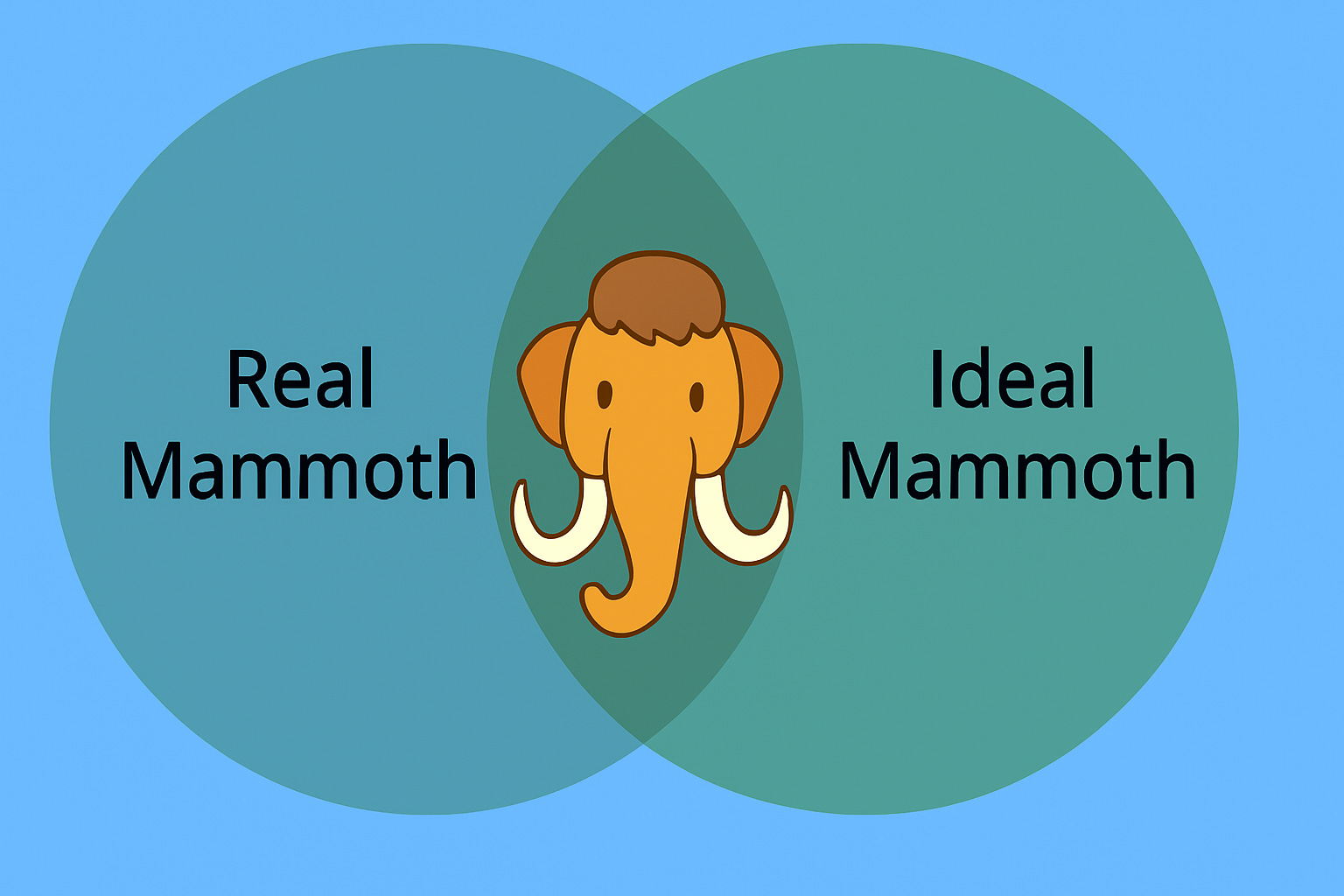
In short, incongruence is that uncomfortable space in-between—and it’s exactly where all the uncomfortable feelings sit. The distance between the two components of the self, a distance that therapy and other practices seek to reduce—but this, in turn, is precisely where growth emanates from. From my personal experience… it’s the best place to start.
Staying in touch with the idea of congruence means recognising the distance between these two states in myself—that’s what kick-started this whole thing. Yet it’s being aware of these states, coming to accept them—and even learning to love aspects of them—that keeps me going.
Let’s start with the “ideal” self. My reasoning is simple: even though it is formed by a rather complex collection of conditions, it is actually the easiest to recognise, because it’s the one we unwittingly focus most of our attention on. This is not necessarily our fault, and it may even be getting harder to avoid as the world evolves at its current rate.
If we look at how and why we form this version of ourselves, it’s easy to understand the struggle. The ideal self often emerges from a blend of societal pressures, media portrayals, family expectations, and cultural norms that paint a picture of what “success” or “perfection” should look like. Think about it: from scrolling through curated social media feeds showcasing flawless lives to absorbing messages from ads, movies, or even well-meaning advice from loved ones, we’re constantly bombarded with ideals that may not align with our authentic experiences. This can create an unattainable benchmark, widening the gap to our real self and fuelling that incongruence we talked about.
Moving on to the “real” self—this one isn’t always the easiest to spot. In fact, it’s the hidden aspect of this self that is responsible for the majority of the discomfort we experience with regard to our mental health. My real self is constantly in conflict! There’s the side of me that wants to isolate from most of the complexity of human existence—yet surrounds himself with people so as not to fall into the hermit camp, fulfilling societal norms. There’s the side of me that wants to throw the laptop off a cliff while walking in nature—yet that sits opposed to the self that wants to sit under a soft yellow bulb and type through the night, all from the warm safety of my familiar desk.
One part of this self was motoring along with a foundation degree (months away from qualification). As we all know, simply qualifying and settling for a working degree would have received the well-dones, the job enhancement, and secured the fact that I’m the first of my siblings to obtain the degree (literally bragging rights only—as my siblings are far more successful than me in most of life’s pursuits). However, this has never been my goal—nor would it have been enough to settle my soul…
So listening to the real self has actually set me back… And that’s the point. Not the setback itself, but the fact that it presents something that doesn’t necessarily offer the “expected” or the “comfortable”. Quite often the real self presents the challenge; it presents the exposed view—the view not often supported, or indeed understood, by others. Why? Because it’s individual. It’s your own. And honestly, how many of us actually sit down to listen to it?
According to Rogers, the real self—also tied to what he called the “organismic self”—represents our true, innate experiences, feelings, and perceptions as they unfold in the moment, free from external distortions. It’s the authentic core driven by our natural tendencies toward growth and self-actualisation, but it often gets buried under layers of conditions of worth placed on us by society, family, or our cultural understandings.
What’s the solution? Well, a lot of hard work, if I’m honest… By tuning into it more intentionally—through self-reflection, therapy, or simply embracing those uncomfortable inner conflicts—we can start narrowing the incongruence, fostering greater congruence and a more fulfilling life. In my case, honouring that “real-self” meant veering off the expected path, but it’s led to this very journey of writing and self-discovery, proving that the discomfort is often the gateway to true alignment.
In the spirit of honesty—and quite possibly the reason I took to writing this post—I have found myself harbouring an undefinable anxiety. I thought that getting back to basics would offer me the answer. Actually, it’s just highlighting the fact that I already know it—I’m just not listening to myself. I often share little grounding practices on social media, but it’s a little trickier when we’re discussing the self. That said, below is one that I regularly implement for myself.
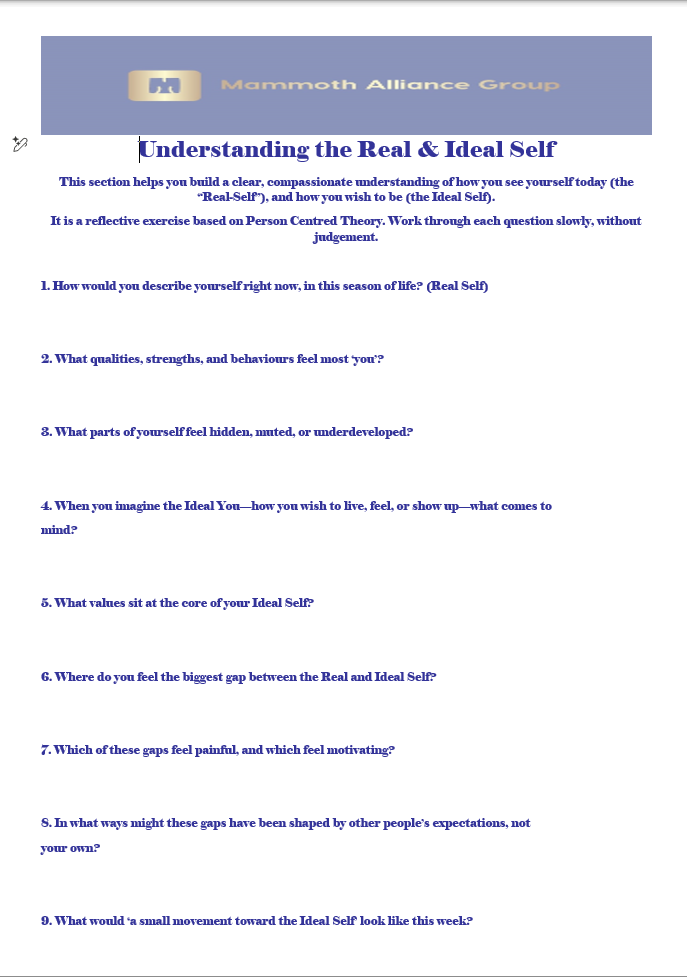
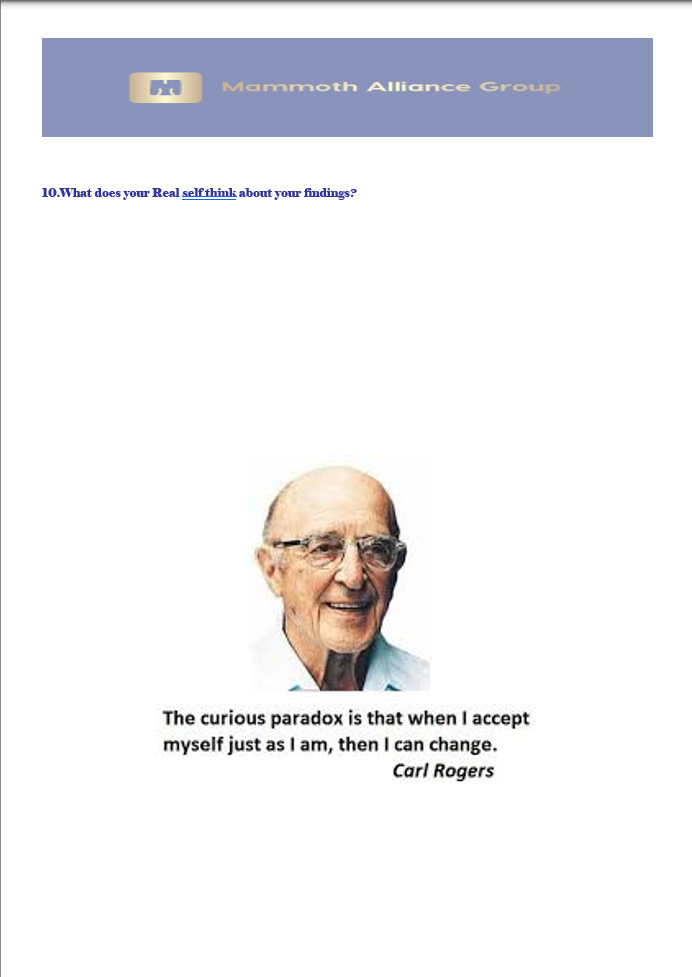
I’ve done my best to put my internal processes into a more accessible format to suit a wider range of people. If this is something you’d like to implement for yourself, feel free to print a copy of my worksheet or cherry-pick what works for you. The important thing to remember in this whole process is that both versions of the self evolve—and that can happen daily. If you do engage in reflective practices, continuity is the key.
We are not fixed, nor are we to be fixed! Sometimes we simply just are… and that will always be enough! By learning to accept the areas that are truly our own, and recognising those that belong to another, we take the first step. Offering them both love and understanding is the hard work—but you owe it to yourself… and your other self!